


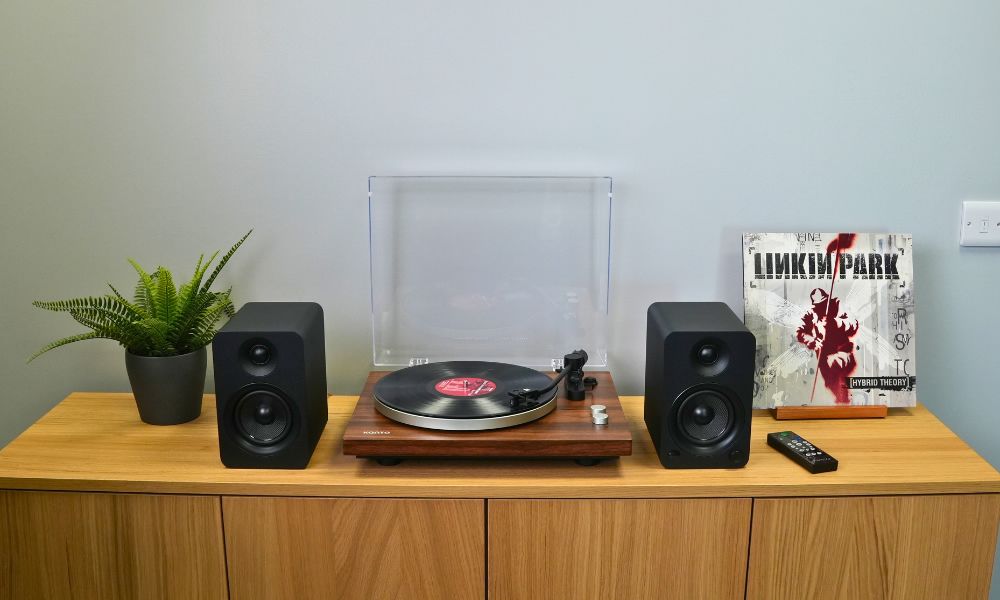
Buying a record player should be exciting but choosing the speakers, understanding the connections and working out whether you need an amplifier can make it feel more complicated than it needs to be.
The good news is that a complete vinyl system can be surprisingly simple.
With the right combination, you can enjoy your records with a turntable, a pair of active speakers and a cable connecting them.
Whether you’re buying your first setup, returning to a collection you’ve owned for years or looking for an upgrade, this guide explains what to look for.
We’ll cover budgets, turntable features, speaker choices and some useful examples from our record player and speaker bundles.
What Do You Need for a Record Player Setup?
A typical vinyl system performs four jobs:
| Component | What it does |
|---|---|
| Turntable | Spins the record while the cartridge and stylus read the groove |
| Phono preamp | Raises the cartridge’s signal to line level and applies the equalisation needed for vinyl playback |
| Amplifier | Provides the power needed to drive the speakers |
| Speakers | Turn the amplified signal into sound |
You need these functions, but you don’t necessarily need four separate boxes.
The phono preamp can be built into the turntable, amplifier or active speakers, while active speakers already contain amplification.
That gives you two main ways to build your system.
The Simple Setup: Turntable & Active Speakers
For many buyers, this is the easiest place to start.
Connect a turntable with a built-in phono preamp to the analogue line input on a pair of active speakers.

The speakers provide the amplification, so there’s no separate amplifier to buy or find space for.
If neither the turntable nor the speakers includes a phono stage, you’ll need to add an external one but most of the turntables we sell at this level do.
The Separates Setup: Turntable, Amplifier & Passive Speakers
Passive speakers need a separate amplifier.
Your turntable connects to that amplifier, with a phono stage included somewhere along the way.

This arrangement gives you more freedom to choose and replace individual components to get the optimal sound quality. It also takes up more space and involves more connections.
Both approaches can sound excellent.
Choose according to your budget, available space and how much flexibility you want.
For a fuller explanation, read our guide to the equipment needed for a turntable and speakers.
Record Player or Turntable: Does The Name Matter?
People often use these terms interchangeably.
“Turntable” usually describes the component that plays the record, while “record player” can also describe a complete unit with amplification and speakers built in.
When shopping, check what is included. On our website we refer to ready to play bundles as a "Turntable & Speakers" or as a "Record Player System" so you know if you're getting a complete system.
A product called a record player does not necessarily contain speakers. For more on the terminology, see the difference between a record player and a turntable.
How Much Should You Spend On A Record Player and Speakers?
Start with a budget for the whole system, rather than choosing a turntable first and seeing what is left for speakers.
If you already own suitable speakers and an amplifier, you can concentrate on the turntable.
If you’re starting from scratch, your budget needs to cover everything required for playback.
The speakers deserve serious consideration. Spending heavily on the turntable while choosing speakers that cannot deliver the sound or volume you want can leave the system feeling unbalanced.
Our turntable budget guide explores that decision in more detail.
For a complete system, these are useful starting points:
| Complete system budget | What to prioritise |
|---|---|
| Under £350 | Straightforward operation, reliable playback and a compatible pair of active speakers |
| £350 - £749 | Compare speaker quality, turntable adjustment, connections and upgrade options |
| £750 and above | Consider premium active speakers or a separates system suited to your room and wider listening needs |
These are shopping brackets, rather than strict boundaries between sound quality levels. Prices and offers change, and different systems put different proportions of the budget into the turntable and speakers.
Allow a little room for cleaning accessories and, where needed, speaker stands or longer cables.
Check what is included before ordering extras.
How to Choose The Right Turntable
The best turntable for you should suit how you want to use it.
Someone who wants push-button playback has different priorities from someone who enjoys adjusting cartridges and experimenting with their system.
Automatic, Semi-Automatic or Manual?
A fully automatic turntable handles the start and finish of playback.
Press the start button and the arm moves into position; at the end of the record, it returns.

Models such as the Audio-Technica LP60X the LP3XBT and LP70XBT make this an accessible option for first-time buyers.
A manual turntable requires you to position the tonearm and lift it when playback finishes. A cueing lever helps you lower the stylus gently.

Semi-automatic features vary. Some turntables lift or return the arm at the end, while an auto-stop function may simply stop the platter. Check the exact behaviour rather than assuming these terms mean the same thing.
Choose automatic operation if convenience matters most.
Choose manual operation if you’re happy with a more hands-on routine.
Neither label, by itself, tells you how good a turntable will sound but our manual versus automatic turntable comparison explains the practical differences.
For more help getting started, see our beginner-friendly turntable guide.
Belt Drive Or Direct Drive?
A belt-drive turntable uses a belt between the motor and platter.
A direct-drive turntable drives the platter directly from the motor.
Belt drive is common among home-listening turntables, including many of our bundles.
Direct-drive models can appeal to buyers who want features such as pitch control and fast starting, although suitability for DJ use depends on the particular model.

For home listening, assess the complete turntable: its speed stability, tonearm, cartridge, build and ease of use. Drive type alone should not decide your purchase.
Read our belt-drive versus direct-drive guide for more background.
Built-In Phono Preamp Or Separate Phono Stage?
A built-in phono preamp makes a simple system easier to assemble.
It lets the turntable feed a normal analogue line input, often labelled AUX or LINE.
A separate phono stage gives you another component to choose and potentially upgrade, but it is not an automatic improvement over every built-in option.
The key is using the correct connection:
| Connection | Turntable setting, where switchable |
|---|---|
| Turntable to an AUX or LINE input | LINE |
| Turntable to a compatible PHONO input | PHONO |
| Turntable to an external phono preamp | PHONO, then connect the preamp’s output to a line input |
Use one phono stage in the signal path. Connecting a line-level output to a phono input can overload it, while connecting an un-amplified phono signal to a line input produces very quiet, thin sound.
Our phono preamp guide explains the role of this component.
Cartridges, Styli & Upgrade Options
The stylus, often called the needle, follows the record groove.
The cartridge converts that movement into an electrical signal.
Before buying, check two separate things: whether the stylus is replaceable and whether the complete cartridge can be changed.
A fixed cartridge does not necessarily prevent stylus upgrades.
The Audio-Technica LP70XBT, for example, has a fixed cartridge but accepts replacement styli from the VM95 range. It offers a useful upgrade route without requiring you to fit and align another cartridge.

Other turntables offer adjustable tracking force, anti-skate and replaceable cartridges. Those features provide flexibility, but also require you to follow the setup instructions carefully.
Read more about turntable cartridges and styli.
Which Other Features Matter?
Most buyers need 33⅓ and 45 RPM playback for LPs and singles.
If you own 78 RPM records, check both speed support and the stylus required for those records.
Bluetooth transmission is useful for placing a turntable away from compatible speakers. USB recording is worth considering if you want to digitise records, but check that a USB connection actually supports audio recording.
A dust cover is practical, too. Allow enough space behind and above the turntable to open it.
How To Choose Speakers For Your Record Player
Your speakers need to suit your room and the way you listen, as well as your turntable.
Active or Passive Speakers?
Active speakers contain amplification. Many pairs place the electronics in one speaker, with a cable connecting it to the second speaker.

Passive speakers require a separate amplifier. This gives you more choice over the amplifier and speakers individually.

An active system can still be upgraded. You can change the turntable or replace the speaker pair later.
However, replacing the speakers also means replacing their built-in amplification.
For a straightforward first system, active speakers are usually the more convenient route.
For buyers who want to build around a particular amplifier or gradually change separate components, passive speakers are worth considering.
Match The Speakers To Your Space
Think about where you will sit and how loudly you usually listen.
A compact pair may suit a bedroom, study or smaller lounge.
A larger room, longer listening distance or preference for higher volumes may justify bigger speakers with greater output.
Measure the available space before buying. Include room for rear connections and follow the manufacturer’s placement guidance.
“Bookshelf speaker” describes a format, rather than an instruction to squeeze the speaker between books. Stands or an open surface may give you more useful placement options.
Check Connections For Your Other Music
Your vinyl system can also handle everyday listening from other sources.
Bluetooth reception is useful for playing music from a phone.
Optical inputs can help with a compatible television or digital source.
Some systems offer USB audio, Wi-Fi streaming or HDMI ARC.
Choose the connections you will actually use.

For example, if you want vinyl and phone playback, analogue inputs plus Bluetooth may cover everything you need.
If you expect to add a subwoofer, check for a suitable output before buying.
Can You Connect A Record Player Wirelessly To Bluetooth Speakers?
Yes, provided the turntable can transmit Bluetooth audio and the speakers can receive it.
These are different functions.
A bundle containing Bluetooth speakers does not necessarily include a Bluetooth turntable.
For example, the standard Audio-Technica LP60X connects to the Edifier R1280DB speakers by cable.
The speakers’ Bluetooth connection lets you stream from your phone.
To send vinyl wirelessly, you need a transmitting turntable such as the LP60XBT or LP70XBT.
If the turntable sits close to the speakers, a wired connection is a sensible starting point. It avoids pairing and the Bluetooth encoding stage so you'll get better sound quality.
Bluetooth is useful when furniture placement makes an audio cable inconvenient. It does not remove the need for power, and many speaker pairs still need a cable between them.
Read our wired versus Bluetooth turntable guide to weigh up the options.
Should You Buy A Turntable & Speaker Bundle?
A bundle can make buying your first system much easier.
You can compare complete setups instead of checking each component separately.
Our record player and speaker bundles bring together selected combinations at different budgets, including compact active-speaker systems and setups with a separate amplifier.

Before choosing, check:
- The exact turntable and speaker models.
- Whether playback is automatic or manual.
- Whether the turntable-to-speaker connection is wired, Bluetooth or either.
- What cables and accessories are included.
- Whether it offers the connections you need for other sources.
Buying separately can make sense if you already own part of a system or have a particular combination in mind.
A bundle is especially useful when you want a complete starting point.
Which Record Player & Speaker Setup Suits You?
These combinations illustrate different buying priorities.
Follow the product links for current pricing, finishes and availability.
For a Straightforward First Setup: Audio-Technica LP60X & Edifier R1280DB
The LP60X and R1280DB bundle combines fully automatic playback with active bookshelf speakers.
The turntable’s built-in phono preamp and the speakers’ amplification keep the equipment list short.
The standard LP60X uses a wired connection, while the speakers also accept Bluetooth audio from a phone.

It’s a sensible starting point if you want to play records without adjusting a counterweight or choosing a separate amplifier.
For Automatic Playback With A Stylus Upgrade Route: Audio-Technica LP70XBT and Edifier R1280DB
The LP70XBT and R1280DB bundle keeps the compact Edifier speakers while changing the turntable.
The LP70XBT offers fully automatic playback, Bluetooth transmission and VM95-series stylus compatibility. Its tracking setup is preset, so you don’t need to balance the tonearm before listening.
Choose this if you value ease of use but also want the option to experiment with a compatible stylus upgrade later.

Our LP70XBT review covers our experience using it.
For a More Hands-On Setup: Kanto OBI3 and YU Speakers
The Kanto OBI3 and YU bundle suits buyers who want manual operation and adjustable settings.
The OBI3 G2 offers an adjustable counterweight, anti-skate, a built-in phono preamp and Bluetooth transmission. Its auto-stop function stops the platter, but does not return the tonearm.
The YU speakers provide amplification, Bluetooth reception and a subwoofer output.

This is a useful combination if you like the involvement of operating the tonearm yourself. Our Kanto OBI3 G2 review explains the setup process and what we found during listening.
For a Step Up with Automatic Convenience: Audio-Technica LP3XBT and Q Acoustics M20
The LP3XBT and Q Acoustics M20 bundle is worth considering when you have more to spend on the complete system.
The LP3XBT combines automatic operation with adjustable tonearm settings. The M20 speakers include amplification, Bluetooth and a subwoofer output.
It provides a route to a more substantial system while retaining push-button record playback. Unlike the preset LP60X and LP70XBT, the LP3XBT requires its tonearm settings to be configured during setup.
For Compact Speakers: Pro-Ject E1.2 and Ruark MR1
The Pro-Ject E1.2 and Ruark MR1 bundle pairs a manual turntable with compact active speakers.
The Pro-Ject E1.2 and Ruark MR1 Mk3 speakers are also available individually.

It’s worth a look if speaker size and appearance are high on your list. The system avoids a separate amplifier, and the speakers also support Bluetooth listening.
Measure the space for the complete arrangement, including the turntable, rather than judging its footprint from the speakers alone.
For a Broader Hi-Fi System: Ruark R610, Sabre Speakers and Pro-Ject T1 EVO
The Ruark R610, Sabre and Pro-Ject T1 EVO bundle takes the separate-amplifier approach.
This system combines the Ruark R610 amplifier, Sabre-R speakers and Pro-Ject T1 EVO turntable.
The R610 provides amplification and a moving-magnet phono input, alongside network streaming, radio and HDMI ARC/eARC connectivity.
Consider this type of system if vinyl is one part of your listening and you want the same equipment to serve several sources.
Where Should You Put Your Record Player and Speakers?
Plan the position before the equipment arrives.
Place the turntable on a stable, level surface. If the tonearm is adjustable, follow the manufacturer’s instructions for tracking force and anti-skate. Use the recommended settings for the fitted cartridge.
Give the left and right speakers some separation and aim for a reasonably balanced listening position between them. Follow their placement guidance and experiment with distance from walls.
Where practical, put the speakers on separate stands or surfaces from the turntable. This helps reduce vibration reaching the stylus. If everything must share a cabinet, leave space between components and consider suitable isolation.
Our record player setup and maintenance guide covers the next steps.
Common Record Player Buying Mistakes
- Buying passive speakers without an amplifier. A built-in phono preamp does not provide the power needed to drive passive speakers.
- Assuming RCA means phono. RCA describes the connector. The signal can be phono level or line level, so check the input label.
- Misunderstanding Bluetooth. Check which device transmits, which receives and which cables the system still needs.
- Overlooking the speakers. Compare complete combinations rather than choosing solely by turntable specification.
- Buying features you won’t use. USB recording, cartridge adjustment and extra inputs are worthwhile only if they serve your plans.
- Forgetting the physical fit. Check the turntable depth, lid clearance, speaker dimensions and cable lengths.
What Accessories Do You Actually Need?
Start with basic care: a suitable record brush, an appropriate stylus-cleaning tool and somewhere to store records upright.
Check the manufacturer’s cleaning instructions, particularly before using liquids on a stylus. Our guides explain how to clean vinyl records and how to clean a turntable stylus.

Speaker stands can be useful if they improve positioning. A tracking-force gauge may help with an adjustable tonearm, but it is not essential for a model with factory-fixed settings.
Avoid buying a pile of upgrades before hearing the system properly set up. Get familiar with it first, then decide whether you want to improve placement, change a compatible stylus or upgrade a component.
Our guide to simple turntable upgrades explains some of those options.
Record Player and Speakers FAQs
Do All Record Players Need Separate Speakers?
No. Some have speakers built in. Turntables without built-in speakers need an external sound system, whether that is active speakers or an amplifier with passive speakers.
Can I Connect a Turntable Directly to Active Speakers?
Yes, if there is a suitable phono stage in the turntable or speakers. Otherwise, add an external phono preamp between them. Follow our turntable and active speaker setup guide for connection advice.
Do I Need an Amplifier and a Phono Preamp?
They perform different jobs, and both functions are needed in a typical magnetic-cartridge system. They do not have to be separate boxes: active speakers contain amplification, and the phono stage may already be built into another component.
Can I Use Speakers I Already Own?
Often, yes. Check whether they are active or passive, what inputs are available and whether your system already includes a phono stage. Knowing the exact model numbers makes compatibility much easier to establish.
Can I Play Music from My Phone Through the Same System?
Yes, if the speakers or amplifier offer a compatible connection, such as Bluetooth reception, network streaming or a suitable wired input. Your phone usually connects to that component, rather than to the turntable.
Can I Listen Through Headphones?
Check for a headphone output on the speakers or amplifier, or Bluetooth transmission from the turntable for compatible wireless headphones. A normal line output is not a dedicated headphone output. See our guide to using headphones with a turntable.
Can Every Turntable Play 78 RPM Records?
No. You need a model that supports 78 RPM and the appropriate stylus for the records. Speed support alone is not enough. Our 78 RPM playback guide explains what to check.
We'd recommend the Audio-Technica LP120XBT-USB or the Dual CS429 if 78rpm is important to you.
What Should I Upgrade First?
Check setup and placement before spending money. After that, address the part of the system that limits what you want: speakers for greater output, a compatible stylus for improved tracking, or different electronics for additional connections.
Find Your Record Player & Speaker Setup
Start with five questions:
- What is your budget for the complete system?
- Where will the turntable and speakers sit?
- Do you prefer automatic or manual playback?
- Do you also want phone streaming, TV sound or headphone listening?
- Would you like adjustment and upgrade options?
For many buyers, a turntable and active speaker bundle provides a straightforward, enjoyable introduction to vinyl. Others will prefer the flexibility of a separate amplifier and passive speakers.
Explore our record player and speaker bundles to compare complete setups. If you’re unsure, tell us your budget, room size and any equipment you already own, and we’ll help you choose a suitable combination.


