


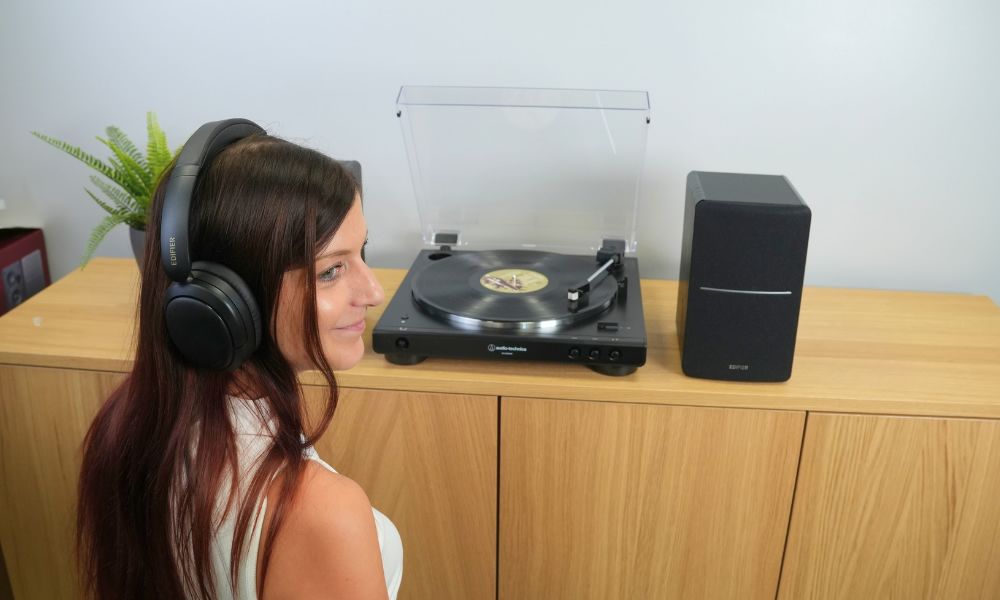
Lift an Audio-Technica LP60X out of its box and the first surprise is how small it is. It's squarer than most turntables, and the dust cover is already fitted before you've touched a screwdriver. Not that you'll need one.
It's also easily our best-selling turntable here at K&B Audio, and it comes in three versions: the standard LP60X, the Bluetooth LP60XBT and the USB-equipped LP60XUSB.
This is a hands-on Audio-Technica LP60X review. We've had the range on test in-house, played it through Edifier speakers both wired and over Bluetooth, recorded vinyl over USB, and tried an upgrade stylus and an external phono stage.
Here's what it's like to live with, and which version makes the most sense for you.
K&B Audio Quick Verdict
Price: From £139.99 (See Latest Pricing)
Pros
- Fully automatic start, stop and return
- Compact, squarer footprint than most turntables
- Switchable pre-amp works with almost any system
- LP60XBT can play wired and over Bluetooth at once
- USB recording on the LP60XUSB is genuinely easy
- Affordable ATN3600LE stylus is a noticeable upgrade
Cons
- Plastic, entry-level build
- Cartridge can't be upgraded, only the stylus
- A bit muddy through the built-in pre-amp, with less detail than pricier decks
- Mechanism is a bit noisy when starting, stopping and changing tracks
- Acrylic lid marks easily
What's in the Box
All three versions come with the same accessories, and the LP60XUSB adds a USB cable.
In the box you'll find:
- The turntable, with the hinged acrylic dust cover already fitted
- Platter with drive belt (and a ribbon to help you fit it)
- Audio-Technica branded felt slip mat
- 45 RPM adapter for 7" singles
- RCA to 3.5 mm audio cable
- External power supply
- Quick start guide
- LP60XUSB only: USB cable (approx. 1.9 m, according to Audio-Technica)
Quick Tip: the cables and power supply are packed in a small box at the end of the polystyrene. It's easy to miss, so check before you throw the packaging away.
Key Specifications
The three versions share the same turntable, so the core specifications are identical.
These figures come from Audio-Technica.
- Operation: Fully automatic, belt drive
- Motor: DC servo-controlled
- Speeds: 33 1/3 and 45 RPM
- Platter: Die-cast aluminium
- Cartridge: Integral Dual Magnet (VM type), replaceable stylus
- Replacement stylus: ATN3600LC (standard), ATN3600LE (elliptical upgrade)
- Phono pre-amp: Built-in, switchable between phono and line output
- Output: 3.5 mm socket (RCA cable supplied)
- Wow and flutter: Less than 0.25% (WTD) at 3 kHz
- Signal-to-noise ratio: More than 50 dB (DIN-B)
- Power: External AC adapter
- Dimensions (W x H x D): 359.5 x 97.5 x 373.3 mm
- Weight: 2.6 kg
- LP60XBT adds: Bluetooth 5.0 transmitter, aptX and SBC codecs, remembers up to 8 paired devices
- LP60XUSB adds: USB output, 16-bit recording at 44.1 or 48 kHz, works with Windows or Mac
First Impressions & Setup
The LP60X arrives well packaged in a glossy retail box. Open it up and the quick start guide and 45 RPM adapter are sitting right on top.
Setup is about as simple as turntables get. Drop the platter on, then use the ribbon provided to loop the drive belt over the gold-coloured motor pulley on the left-hand side. Pull the ribbon out, add the slip mat and plug it into your speakers.
Audio-Technica's manual also asks you to turn the platter ten times by hand before first use, which only takes a few seconds and is an important step to ensure the start/stop mechanism works correctly.
There's no counterweight to balance and no anti-skate to set. Everything is set at the factory and there's nothing to adjust, so you're up and running almost instantly. For a first turntable, that's a big part of the appeal.

Audio-Technica LP60X Hands-On Review
Sound Quality
The LP60X is a good sounding turntable, and far better than a typical suitcase record player.
We did most of our listening through a pair of Edifier R1280DB active speakers.

The sound quality using the built in pre-amplifier is decent enough for the money but, whilst listening to Linkin Park's In the End, a fairly bass-heavy track, the built-in pre-amp sounds a bit muddy and there isn't much separation.
As a starter turntable at the low price price point it's far better than you'd expect.
We had no hum or buzz with anything we connected it to. At higher volumes you can hear a little more stylus noise than you would on a pricier deck, but it's not really an issue once the music is playing.
Upgrading the Sound: Stylus & Phono Stage
You can't swap the cartridge on the LP60X, so the main upgrade route is the stylus.
The ATN3600LE elliptical stylus costs £25, less than a tenner more than the standard ATN3600LC.
We swapped between the two and the difference is noticeable. If your stylus is due for replacement anyway (Audio-Technica suggests around 400 hours of use), the LE is well worth the extra.
The other route is the phono stage. Other reviews have pointed to the built-in pre-amp as the weak link in the LP60X range, so we put that to the test.
We switched it off and ran the turntable through a Pro-Ject Phono Box S2 (£159).
The improvement was substantial. There was more volume for starters, but also a lot more detail and separation, and a better soundstage. Going back to Linkin Park's In the End, the difference was very noticeable, and adding the LE stylus improved it further still.
To be fair, a £159 phono stage costs more than the turntable, so it's not a pairing we'd normally suggest but based on what we heard, though, Pro-Ject's Phono Box MM (£59) or Phono Box (£99) would be a cracking upgrade for the LP60X at a more reasonable price point.
If your amplifier or speakers already have a phono stage built in, switching the LP60X's pre-amp off and using theirs is quite likely to be a big step up at no extra cost.
One side effect: through the better phono stage, the mechanism noise when starting, stopping and changing tracks becomes more noticeable. Once a record is playing, it isn't an issue.
Automatic Operation in Use
The controls are simple. A speed switch for 33 and 45 RPM sits on the left of the front panel, with start, stop and tonearm lift buttons on the right. A switch on the plinth sets the record size to 7" or 12".
Press start and the tonearm lifts, moves across and drops onto the record. When the side finishes, it returns to its rest and the platter stops.
The lift button lets you raise the arm, skip a track and lower it back down.
We've had no problems with the start and stop mechanism during our testing.
The one thing to know is that you should let it finish what it's doing. After you press stop, it takes a few seconds for the platter to stop spinning, don't interfere with the tonearm while it's moving.
If you do interrupt it and the mechanism gets out of sync, here's the fix we use: hold the tonearm up with your right hand and turn the platter by hand ten times. Ideally, though, just let it do its own thing.
Got some 10" records? The size switch only offers 7" and 12", but you can still play them. Start the turntable as normal and, with the tonearm lifted, move it by hand to the start of the record, then press the lift button to lower it.

Bluetooth: LP60XBT
The LP60XBT is the same core turntable with a Bluetooth transmitter added.
It sends your records wirelessly to Bluetooth speakers, soundbars or headphones, so the turntable doesn't have to sit next to your speakers. It still needs to be plugged into the mains, though.
Audio-Technica quotes a range of around 10 m line of sight, so think of it as a same-room solution.
Pairing is easy. Turn off anything else Bluetooth nearby so it's just the turntable and the device you want to connect. If you're pairing with active speakers or an amplifier, make sure your phone isn't already connected to them, or the turntable won't find them.

The clever part is that you don't have to choose between wired and wireless.
Audio-Technica says sound plays through both if your wired system is left on, so you can cable it to your speakers and use Bluetooth headphones for late-night listening.

We paired ours with our speakers rather than headphones, but the pairing process is the same.
We used the LP60XBT with our R1280DB speakers both wired and over Bluetooth. As you'd expect, Bluetooth doesn't sound quite as good as a cable, but it's usually more than good enough and it works well.
If you want to switch Bluetooth off completely, press and hold the Bluetooth button for about ten seconds. The light flashes red and then goes off.
Note: If you have the turntable connected via cable and Bluetooth at the same time, both devices will play back, however you'll likely notice a lag between the two. It's not designed for dual playback, if you're Bluetooth'ing to your headphones then leave your speakers switched off.
USB Recording: LP60XUSB
The LP60XUSB's party trick is recording your records onto a PC or Mac, which is handy if you want to digitise an old collection.
We set it up with Audacity, which is free, and it was very easy:
- Connect the turntable to your computer with the USB cable
- Install Audacity and set the recording device to the turntable's USB input
- Start the record and press record in Audacity
- Press stop when you're done and save the file, for example as an MP3
The recordings sounded pretty decent from what we tested.

Audio-Technica lists 16-bit recording at 44.1 or 48 kHz.
Despite selling turntables for a number of years I've never really tested a USB recording turntable personally, and I was quite surprised at just how quick & easy it was to get set up and recording!
Build & Design
This is a plastic, entry-level budget turntable.
That said, it's well built and fairly sturdy, and quite nice looking too.
It's also one of the more compact turntables we've seen, closer to square than the usual rectangle. At 359.5 mm wide and 373.3 mm deep, it's a good choice if space is tight.
Small touches help. The Audio-Technica branded slip mat is a nice detail, and there's a recess in the plinth to store the 45 RPM adapter so it doesn't go missing.
The acrylic dust cover stays up on its own and pulls straight off its hinges if you'd rather remove it. It does mark easily though so we'd avoid stacking records on top of it and be careful when cleaning it.
In the UK, the body is black on all three versions and only the front panel changes. The LP60X has a black front, the LP60XBT comes in black or white, and the LP60XUSB has a gunmetal grey front. You may see other colours online, but not every colour is sold in every market.

Personally, we think the gunmetal grey LP60XUSB is the best looking of the three. We'd happily buy it for the looks alone, even with no plans to record anything!
Compatibility & Speaker Pairing
Around the back you'll find the power input, a 3.5 mm output (with an RCA cable supplied) and the switch for the built-in pre-amp. That pre-amp is what makes the LP60X so versatile.
With it switched on, you can plug the turntable straight into active bookshelf speakers, a soundbar, Bluetooth speakers with a wired input or an amplifier. Whatever you've got, you can probably plug it into.
With it switched off, it works with a phono input, and we had no issues running it that way.
Active bookshelf speakers are an extremely popular system with our customers. We tested it with the LP60X and Edifier R1280DB bundle (£259.99), and you can see why it's so popular. In our view, there's no real better way to listen to your records for the money, and you can upgrade the speakers or the turntable later.
Our most popular pairing is actually the LP60X with Edifier R1280T speakers (£239.99). They sound the same as the R1280DB, but the R1280DB adds Bluetooth streaming and more connections, which makes it the better all-rounder and much better value for money overall.
The R1280T works out cheaper if the turntable is your only source. You can read more in our Edifier R1280DB review.
LP60X Comparisons: Versions & Alternatives
LP60X vs LP60XBT vs LP60XUSB
All three share the same turntable, cartridge and sound when wired.
The only real differences are connectivity, finish and price (correct at the time of writing).
- LP60X (£139.99): The one to buy if your turntable will be wired to your speakers or amplifier.
- LP60XUSB (£149.99): Adds USB recording for just £10 more, plus that gunmetal grey front.
- LP60XBT (£179.99): Adds Bluetooth for wireless speakers or headphones, while keeping the wired output.
Alternatives Worth Considering
If you like the idea of a fully automatic turntable but want more, these are the models we'd look at. Prices are correct at the time of writing.
Audio-Technica LP70XBT (£219): The direct step up. It's a much nicer looking turntable, the components are a little better throughout, and it uses an AT-VM95C cartridge that accepts any VM95 series stylus, so you have a proper upgrade path. Read our full Audio-Technica LP70XBT review.
Audio-Technica LP3XBT (£279.99): A much more serious turntable that's still fully automatic. You get an adjustable counterweight and anti-skate, an AT-VM95C cartridge on a removable universal headshell, and far better components out of the box. It costs more, but it's a big step up.
Victrola Automatic Bluetooth (£219): In our opinion a slightly better turntable than the LP60X, and it looks nicer, with a handy repeat button. It's still very plastic, though, and at £219 it's really an alternative to the LP70XBT.
Kanto OBI3 Gen 2 (£179.99): Our curveball, at the same price as the LP60XBT. It isn't fully automatic: you move the arm over yourself and lower it with the cue lever, which starts the platter, and it stops automatically at the end of a side. In return, it's far nicer looking and much better made, with an adjustable counterweight, anti-skate and pitch control.
The Kanto uses a cartridge from the same AT3600 family as the LP60X, yet it sounds better in our listening, so its advantage is the build, control and style rather than the cartridge. It's the one we'd personally choose, but it comes down to whether you want a traditional manual turntable or the convenience of automatic start and stop. Read our Kanto OBI3 G2 review for more.
Who the Audio-Technica LP60X Is Best For
- First-time vinyl buyers: Anyone getting into vinyl who doesn't want to spend a fortune, but wants to avoid the cheap suitcase players that can be hard on your records.
- Teenagers and younger listeners: Paired with speakers like the Edifier R1280DB, it makes a brilliant, easy first system.
- Anyone getting back into vinyl: A fully automatic system that's easy to use and sounds very good without costing a fortune.
- Late-night listeners and collection digitisers: The LP60XBT adds Bluetooth headphone listening, and the LP60XUSB makes recording your records onto a computer easy.
Known Limitations
- No cartridge upgrade: The cartridge is built in, so the stylus is the only part you can upgrade.
- No adjustments: There's no counterweight or anti-skate to tweak. That's great for simplicity, less so if you want to fine-tune.
- Two speeds, two sizes: It plays 33 and 45 RPM, and the size switch only covers 7" and 12". 10" records need a little manual help, and it won't play 78s.
- Mechanism noise: The auto mechanism is a little noisy when starting, stopping and changing tracks, more so through a better phono stage.
- Bluetooth range: The LP60XBT is designed for same-room use, and Bluetooth doesn't sound quite as good as a cable.
- Stylus wear: Audio-Technica recommends replacing the stylus after around 400 hours of use. Keeping it clean helps, and our guide on how to clean your turntable stylus shows you how.
Final Thoughts
In our view, the Audio-Technica LP60X is probably the ultimate entry-level turntable.
It's very easy to use, compact and versatile, which is why it's easily our best-selling turntable.
Spend more and you will get better sound, but you'd need to find around £100 more for a much better system. If however the LP60X maxes out your budget, sound for pound, it's pretty unbeatable.
Pick the version that matches how you'll listen: the LP60X for a wired system, the LP60XBT for wireless speakers or headphones, or the LP60XUSB for recording (or that gunmetal finish!).
If you need speakers too, take a look at our turntable and speaker bundles.
FAQs
Is the Audio-Technica LP60X good for beginners?
Yes. It's fully automatic, needs no tonearm setup and plugs straight into active speakers thanks to its built-in pre-amp. It's also easily our best-selling turntable.
What's the difference between the LP60X, LP60XBT and LP60XUSB?
They're the same turntable. The LP60XBT adds a Bluetooth transmitter for wireless speakers and headphones, and the LP60XUSB adds a USB output for recording to a PC or Mac.
In the UK, the LP60X has a black front, the LP60XBT comes in black or white, and the LP60XUSB has a gunmetal grey front.
Can you upgrade the Audio-Technica LP60X?
The cartridge can't be changed, but you can fit the ATN3600LE elliptical stylus for £25, which made a noticeable difference in our testing.
You can also switch off the built-in pre-amp and use a better external phono stage, such as Pro-Ject's Phono Box MM, or the one in your amplifier or speakers.
Does the LP60X need an amplifier?
Not if you have active speakers. The built-in pre-amp lets you plug it straight into active bookshelf speakers, a soundbar or Bluetooth speakers with a wired input.
With passive speakers though, you'll need an amplifier.
Can the Audio-Technica LP60X play 10-inch records?
Yes, with a little help. The size switch only covers 7" and 12", so start the turntable as normal and, with the tonearm lifted, move it by hand to the start of the record. Then press the lift button to lower it.
How do you record vinyl with the LP60XUSB?
Connect it to your PC or Mac with the USB cable, install the free Audacity software and set the recording device to the turntable's USB input. Play your record, press record, then press stop when you're done and save the file, for example as an MP3.


