


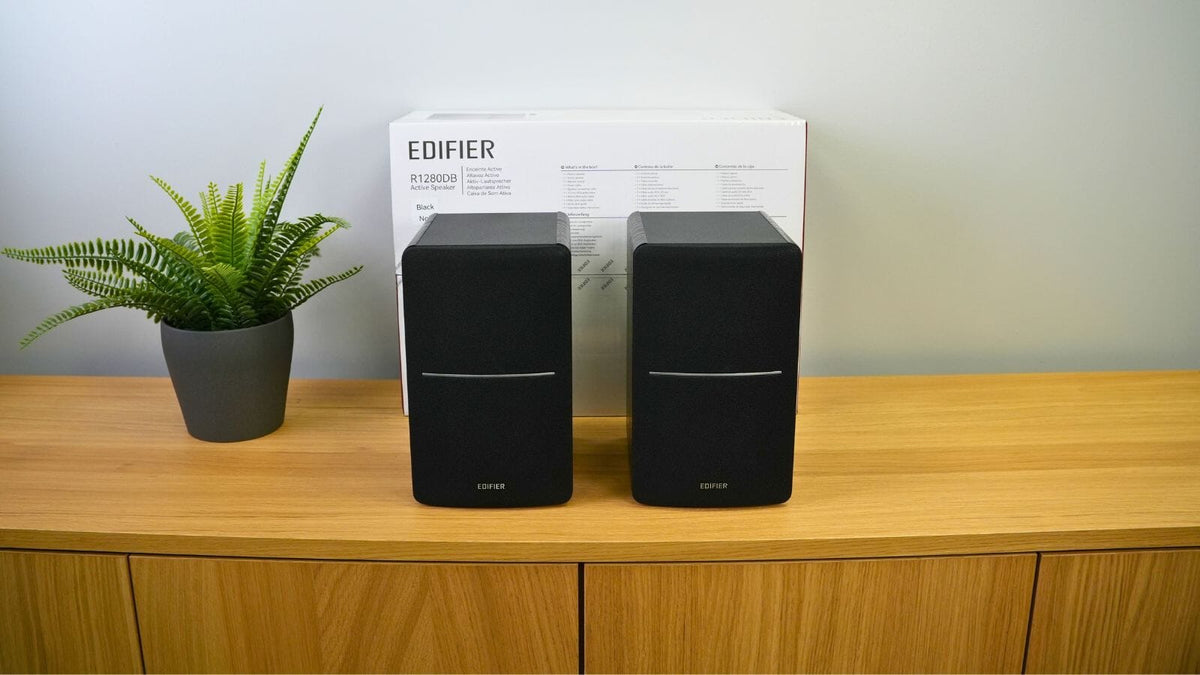
We opened all three finishes of the Edifier R1280DB here at K&B Audio, in wood, black and matt white, and the first thing that stood out was how solidly made they feel for a £129.99 pair of speakers.
This Edifier R1280DB review is a hands-on test. We set them up, streamed to them over Bluetooth, paired them with a turntable and put the controls through their paces.
If you want one simple system for streaming, vinyl and TV without buying a separate amplifier, this review will tell you whether the R1280DB is the right fit, and when one of its siblings makes more sense.
K&B Audio Quick Verdict
RRP: £129.99 (See Latest Pricing)
Pros
- Sound quality well above what the price suggests
- Didn't distort at higher volumes in our testing
- Bluetooth, optical, coaxial and two RCA inputs
- Switch sources without unplugging anything
- Well made, with three good-looking finishes
- Bluetooth reconnects automatically once paired
Cons
- No subwoofer output
- No HDMI, and the coaxial input will go unused for most people
- Very basic remote control
- Bass can get a little muddy
- No phono stage or headphone output
What's in the Box
The R1280DB arrives in a gloss retail box, with enough cardboard protection inside to get it to you safely.
- Active (right) speaker
- Passive (left) speaker
- Speaker connecting cable (2.5m)
- RCA to RCA audio cable
- 3.5mm to RCA audio cable
- Fibre optic audio cable
- Remote control
- Quick start guide and safety instructions
There's no coaxial cable included, so you'll need your own if you plan to use that input.
Key Specifications
- Power output: 21W + 21W RMS (42W total)
- Drivers (per speaker): 13mm silk dome tweeter + 4" (116mm) mid/bass driver
- Frequency response: 55Hz – 20kHz
- Signal-to-noise ratio: ≥ 85dB(A)
- Inputs: Bluetooth, optical, coaxial, 2 x RCA line-level
- Digital input format: PCM 44.1kHz / 48kHz only (optical and coaxial)
- Outputs: Speaker output to the passive speaker only (no sub out, no headphone out)
- Enclosure: MDF, with a front-facing bass port
- Dimensions (W x H x D): 146 x 234 x 196mm per speaker
- Weight: 4.9kg
- Finishes: Wood, black, matt white
- Warranty: 2 years
Specifications are taken from Edifier's official listing and manual. Edifier's published sources don't agree on the specific Bluetooth chipset version, so we've asked Edifier to confirm it and will update this review when they reply.
First Impressions & Setup
Out of the box, the R1280DB feels like proper hi-fi speakers rather than a pair of plastic computer speakers.
They're made from MDF with a wood-effect veneer so are quite sturdy and good quality.

The grilles are fabric and pop off if you'd rather see the drivers. We genuinely think they look good both ways, so it comes down to taste.
The right-hand speaker is the active one. It houses the amplifier, all the inputs and the controls, and connects to the passive left speaker with the supplied 2.5m cable.
That's worth knowing before you plan your layout, because the power lead and all your source cables will be coming off the right-hand side.
Setup itself is simple. Connect the two speakers, plug in your sources, power on and pick an input.
We often sell this speaker for use with a turntable, and it's easy to see why! It's super-simple to setup and sounds great.
One of the most popular bundles is the LP70XBT with R1280DB. Great value for money.

Edifier R1280DB Hands-On Performance
Sound Quality
This was the most surprising part of our test.
At £129.99 you'd be forgiven for keeping your expectations fairly low. They'll surprise you.
The R1280DB was loud enough to fill most normal-sized rooms at home. It sounded relatively clear, and in our testing it didn't distort when we pushed the volume up.
Bass is decent for the size. It can get a little muddy, but at this price point it's still better than expected.
Let's be clear: this isn't audiophile quality. But listen to a pair and it's easy to see why the R1280DB is one of our best-selling active bookshelf speakers under £200.
Features in Use
Bluetooth. Switch to Bluetooth mode and the light flashes blue. Connect from your phone or tablet and the light goes solid, and from then on anything your device plays comes through the speakers.
To switch to another device, disconnect the first one and the R1280DB drops back into pairing mode, ready for the next.
We had no dropouts at 4-5 metres in the same room.
Switching sources. Once everything's plugged in, you never need to touch a cable again. Either use the remote, or tap the volume knob on the side of the active speaker to cycle through the inputs.
Tone controls. The bass and treble dials sit on the side panel and make a noticeable difference, so you can tune the sound to your room and your taste.

Remote control. It's small and very basic. It's nothing to write home about, but it does the job it's meant for: power, volume, mute, direct input selection and Bluetooth playback controls. The bass and treble are adjusted on the speaker only.

Build & Design
The speakers are really well made, and all three finishes look good.
Edifier says the MDF cabinets are designed to reduce resonance and distortion.
What we can say is that they feel solid and look far more like traditional hi-fi than most speakers at this price.

Personally I'm not a fan of the matt white, however I must admit that beside a white turntable the overall bundle does look the part.

Connectivity & Compatibility
Around the back of the active speaker you'll find the amplifier board and all your inputs:
- 2 x RCA: for two analogue sources, such as a turntable and a CD player
- Optical: for a TV or CD player
- Coaxial: for a media streamer or CD player
- Speaker output: to the passive left speaker

Honestly, we don't think many people will use the coaxial input. We'd much rather have seen an HDMI input in its place, which would make TV connection easier and better.
For TVs, Edifier's manual states that the optical and coaxial inputs only decode PCM audio. In practice, that means setting your TV's audio output to PCM for it to work correctly. Not really an issue, just something to be aware of.
Note that the black R1280DB we opened had a standard figure 8 socket for the power lead. All previous models have a pre-wired power lead that can't be removed. We've noticed that this isn't consistent across all models yet but looks like Edifier are moving this way for future models which is a great little update.
How It Compares
At this price, it's really Edifier vs Edifier.
Here's how the R1280DB stacks up against the models customers most often weigh it against.
Our comparisons are based on our own experience with these speakers, alongside the manufacturer specifications. Prices are correct at the time of writing.

Edifier R1280DB vs R1280T
The R1280T (£99.99) is the same core speaker, but without Bluetooth or the digital inputs.
If you're only ever going to use a turntable, it's a sensible saving but Bluetooth makes the R1280DB far more versatile because you can stream music straight from your phone as well.
If you can afford the extra £30 I'd suggest going for the DB version every time.
Edifier R1280DB vs R1280DBs
The R1280DBs (£139.00, wood or black) is the same speaker with three extras:
- A subwoofer output
- A better remote control
- Edifier's "Soundfield Spatializer" mode, which is essentially a set of preset EQs
If a subwoofer is on your wish list, this is the one to go for.
I'd rather Edifier simply added the sub out to the R1280DB and kept the range simpler - is the R1280DBs worth the extra £10? Yes for sure!
Edifier R1280DB vs R1700BT
The R1700BT is the same price at £129.99.
It keeps Bluetooth and dual RCA inputs, but drops the optical and coaxial inputs.
In exchange, you get 66W of power and a noticeable upgrade in sound quality.
If you don't need to connect a TV digitally, it's a strong alternative.
Edifier R1280DB vs R1855DB
The R1855DB (£159.99) is a good step up.
It essentially pairs the power and sound upgrades of the R1700BT with all the digital inputs of the R1280DB, and adds a subwoofer output.
The catch is that it only comes in black, which puts some people off.
Stepping Up: Kanto YU
Move away from Edifier and prices climb quickly, although quality does too.
The Kanto YU is currently priced at £269 and whilst it's twice the price, it's also twice as good!
You get much better sound quality from a similarly sized unit as well as a much better remote control.
In terms of connections you get the basics: RCA, Bluetooth & Sub Out.
If your budget stretches this is a great step up which is notably better in sound quality, but otherwise from where we sit, Edifier really owns the sub-£200 active bookshelf speaker market.
The value for money the R1280DB brings to the table (or sideboard!) is hard to beat.
Who the Edifier R1280DB Is Best For
- First-time vinyl buyers: connect a turntable with a built-in preamp to one RCA input and you have a complete record player setup, with Bluetooth ready for everything else.
- Living rooms that need one system for everything: phone, TV and a CD player can all stay connected, and you swap between them with the remote.
- Home offices and bedrooms: the size and output suit a normal-sized room without overwhelming it.
- Buyers on a tight budget: if £129.99 is your ceiling, in our experience we haven't found anything cheaper that sounds this good.
Known Limitations
- No subwoofer output. Choose the R1280DBs or R1855DB if you want to add a sub later.
- No phono stage. Your turntable needs a built-in preamp, or you'll need a separate phono preamp.
- No HDMI. TVs connect via optical only, and your TV must be set to PCM audio output. Volume is controlled at the speakers, using the side dial or the Edifier remote.
- No headphone output.
- The active speaker is always the right-hand one. Plan your layout around the power socket and your sources.
- Bluetooth codecs aren't published by Edifier. The Bluetooth version is also awaiting confirmation.
Read More:
- The Complete Turntable & Record Player Buying Guide
- Edifier R1280DB vs Edifier R1700BT: How They Compare
- How To Connect A CD Player To Active Speakers or An Amplifier
Final Thoughts
The Edifier R1280DB isn't perfect, but it does offer great value for money.
We'd happily trade the coaxial input for HDMI though, and there's no sub out.
But for £129.99 you get a well-built pair of speakers with five inputs and sound that genuinely surprised us.
It's an easy recommendation for anyone who wants one simple system for streaming, vinyl and TV.
See the Edifier R1280DB or browse our full range of active bookshelf speakers.
FAQs
Do the Edifier R1280DB need a separate amplifier?
No. The amplifier is built into the right-hand speaker, which powers the passive left speaker through the supplied cable. You just plug in and play.
Can I connect a turntable to the Edifier R1280DB?
Yes, via either RCA input. The R1280DB has no phono stage, so you'll need a turntable with a built-in preamp or a separate phono preamp. Our record player and speaker bundles take the guesswork out of it.
Why is there no sound from my TV through the optical input?
According to Edifier's manual, the optical and coaxial inputs only decode PCM audio at 44.1kHz or 48kHz. Go into your TV's sound settings and change the digital audio output to PCM. If it's set to Auto, Dolby or Bitstream, you may get no sound.
Can I control the R1280DB's volume with my TV remote?
No. With an optical connection, the volume is controlled at the speakers, using the side-mounted dial or the Edifier remote.
Does the Edifier R1280DB have a subwoofer output?
No. If you want to add a subwoofer, look at the R1280DBs, which is the same speaker with a sub out, or the more powerful R1855DB.
What's the difference between the Edifier R1280DB and R1280T?
They share the same core speaker. The R1280T has two RCA inputs only. The R1280DB adds Bluetooth plus optical and coaxial digital inputs, making it far more versatile for streaming and TV use.


